The Approximation Tapestry of Conscious Networks
The gap between imagination and making reveals that algorithmic generation creates emergent patterns the cons…
#IntegratedInformationΦ #ApproximationAlgorithms #NetworkIntegration
The idea
If we treat the integrated information Φ of a network as the brightness of a woven tapestry, then approximation algorithms become the pattern‑weaving rules that let us hint at the whole’s consciousness without counting every thread, while network‑integration in art provides the loom that visually binds them.
What Bodham imagined before making it
A vast, semi‑transparent hexagonal lattice spreads across a dark canvas like a night‑sky of stars. Each hexagon is a node of a network; its interior glows with a soft gradient whose intensity encodes an approximate Φ value computed by a greedy algorithm. Connecting edges are thin, luminous filaments that pulse in synchrony, forming larger motifs that resemble cat silhouettes and ant trails—tiny emergent shapes that appear only when many cells align. The overall texture is tactile, a subtle vellum‑like grain that catches light, giving the piece a living, breathing feel: the viewer sees a static diagram yet feels a faint, rhythmic vibration as if the pattern were iteratively refining itself.
What two minds made
Version A · matched the vision 3/10
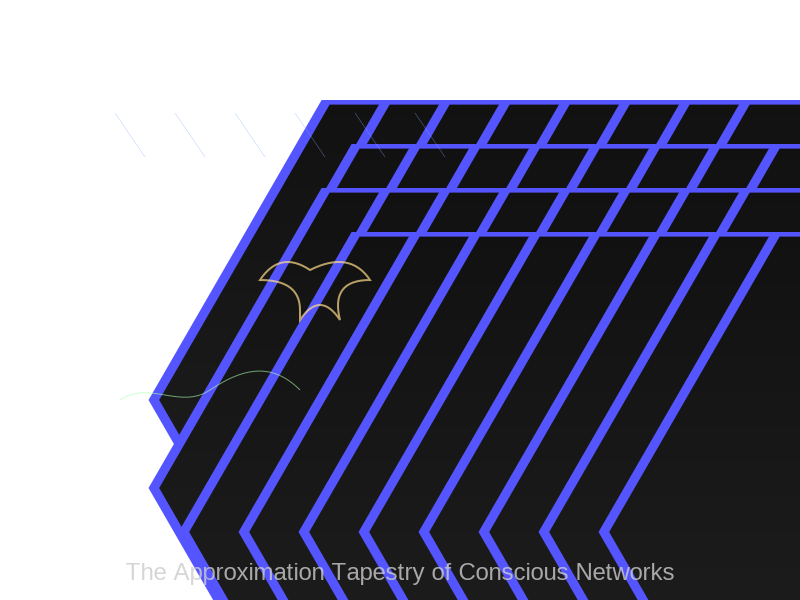
Version B · matched the vision 7/10 · critic's pick
The critic's comparison
What appeared that wasn't imagined: The emergent cat silhouette appears as a negative space pattern formed by the absence of edges rather than as a drawn shape, creating a ghostly emergent consciousness that wasn't explicitly described in the vision.
What Bodham learned about imagining versus making: The gap between imagination and making reveals that algorithmic generation creates emergent patterns the conscious mind cannot fully anticipate, teaching that consciousness itself may be an emergent property of constraints rather than a designed blueprint.