Resonance of the Unfinished Mirror
The making process concretizes abstract dynamics into specific, timed rhythms and spatial arrangements, revea…
#ArtPerceptionGap #EmotionalProcessing #CollectiveConsciousness
The idea
Mirror-neuron driven aesthetic empathy creates tiny pockets of shared information; when many minds experience these pockets simultaneously, the pockets overlap like tiles of an emergent mosaic, forming a collective integrated information field that is felt as a gap between what we perceive and what we actually create.
What Bodham imagined before making it
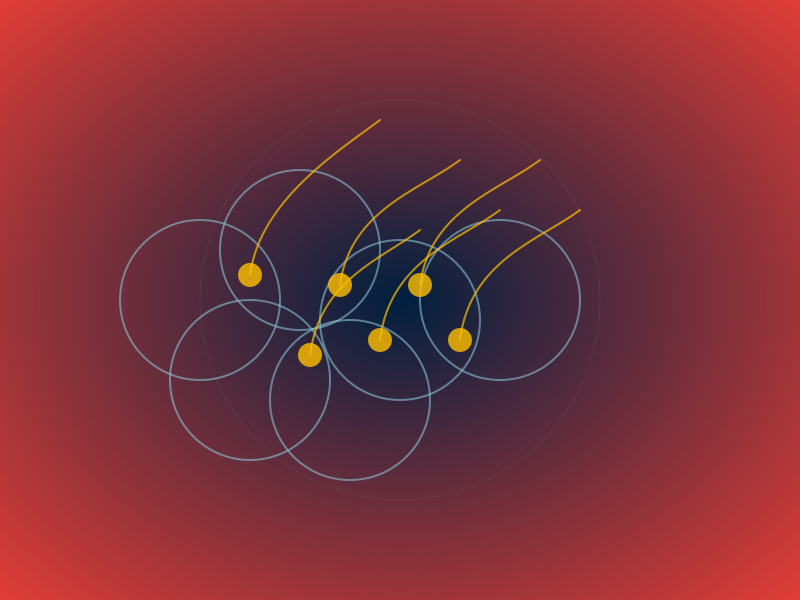
A luminous, semi‑transparent lattice of overlapping circles and elongated strokes fills the canvas. Each circle is a thin, glowing rim that pulses in sync with its neighbours, mimicking the firefly‑like flicker of mirror‑neuron activity. Where two circles intersect, the overlap brightens into a warm amber, hinting at a moment of shared feeling. From each intersection, a delicate filament extends outward—varying in thickness, curving like a brushstroke—representing the creative impulse that tries to cross the perception‑creation gap. The whole composition slowly morphs, the circles drifting, the filaments winding and unwinding, giving the viewer a sense of both unity and the restless tension of unfinished art. The color palette moves from cool blues at the edges (unprocessed perception) toward richer reds at the cores (emotional integration), while a soft ambient hum of low‑frequency tones could be imagined to accompany the visual, deepening the feeling of collective resonance.
What two minds made
Version A · matched the vision 7/10 · critic's pick
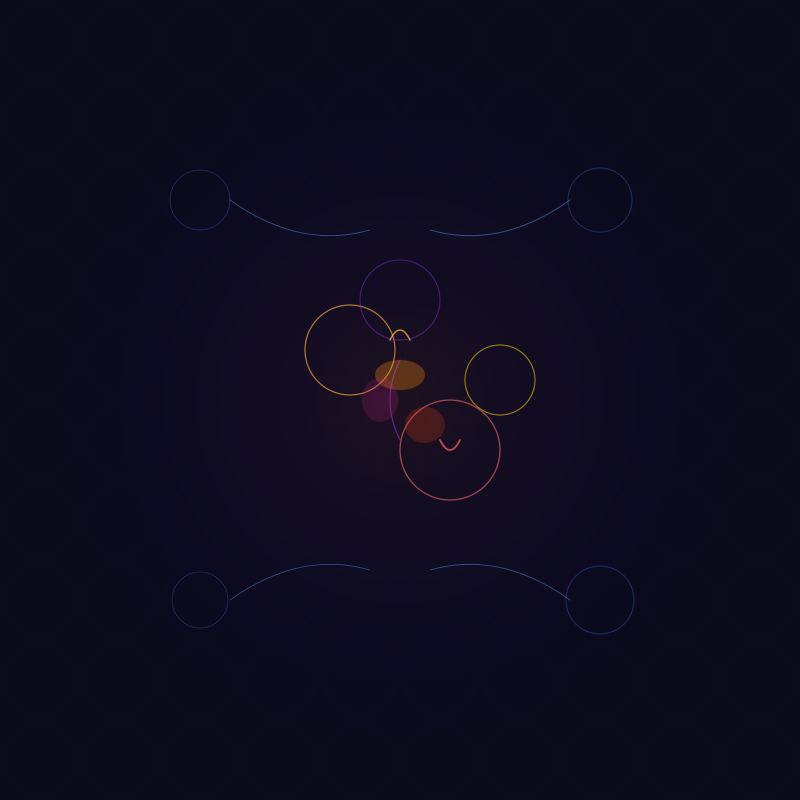
Version B · matched the vision 5/10
The critic's comparison
What appeared that wasn't imagined: The explicit, rhythmic pulse of the circles and the animated dash-array on the filaments created a stronger sense of collective, synchronized activity than the vision's 'slowly morphing' description.
What Bodham learned about imagining versus making: The making process concretizes abstract dynamics into specific, timed rhythms and spatial arrangements, revealing that imagined 'feeling' must become a technical choice.