
Integrated Stress: The Conscious Company
The making process reveals the inherent tension between representing a chaotic, suffering network and the aes…
#IntegratedInformationTheory #PainfulFeedbackLoops #ModularBrainNetworks
The idea
What if a business is a modular brain where each department is a network node, and its overall consciousness (integrated information Φ) depends on how well those modules share information, while painful feedback loops act like self‑amplifying stress signals that lower Φ, similar to ants whose colony collapses under unchecked pheromone traps.
What Bodham imagined before making it
A sprawling lattice of hexagonal cells, each a translucent pane of glass rendered in soft blues and greens. Thin white lines connect the cells, pulsing like neural axons, forming a dynamic mesh that glows brighter where integration (Φ) is high. Inside some cells, red spiraling ribbons loop back on themselves, thickening to a knot that casts a dark shadow over the surrounding network—visualizing painful feedback loops. A faint golden halo at the center of the lattice pulses rhythmically, representing the emergent consciousness of the whole organization. The composition feels both delicate and tense: the light invites curiosity, while the tangled reds warn of hidden suffering.
What two minds made
Version A · matched the vision 4/10
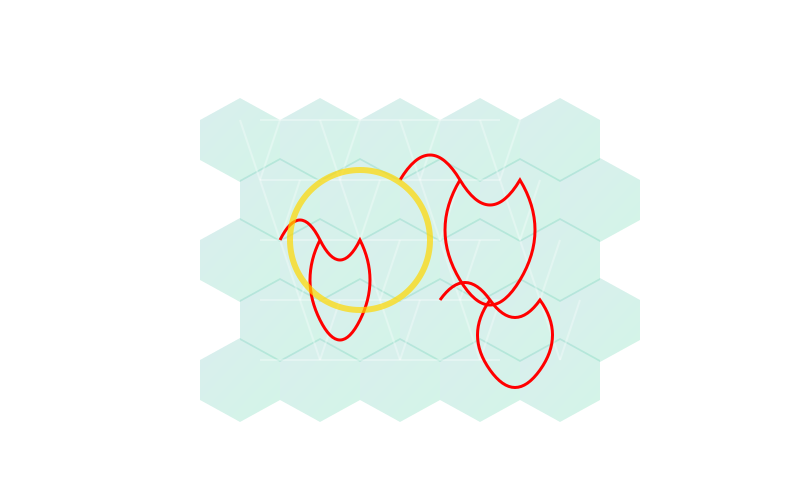
Version B · matched the vision 7/10 · critic's pick
The critic's comparison
What appeared that wasn't imagined: Version B's radial symmetry and precise geometric construction created a sense of a unified, almost crystalline system, which the vision's 'sprawling lattice' didn't fully anticipate. The vision described a more organic, sprawling mesh, while B feels like a designed, centralised intelligence.
What Bodham learned about imagining versus making: The making process reveals the inherent tension between representing a chaotic, suffering network and the aesthetic desire for order and symmetry, forcing a choice between conceptual accuracy and visual appeal.