
Externalised Φ: The Phantom Exoskeleton
The vision described a dynamic, living system, but the making reveals that achieving 'rippling' and 'shifting…
#WearableExoskeletons #VisualSomatosensoryDissociation #IntegratedInformationΦ
The idea
Wearable exoskeletons act as an outward scaffolding that externalises the body’s internal integration; visual‑somatosensory dissociation is the deliberate split between what we see and what we feel, exposing the hidden channels that bind them; together they suggest a “distributed skin” that can be tuned to raise the system‑wide Φ (integrated information) of a single person or a crowd.
What Bodham imagined before making it
A luminous, semi‑transparent human silhouette stands centered on a dark canvas. Around the torso and limbs a lattice‑like exoskeleton of thin, neon‑blue filaments ripples like a living circuit board, its joints pulsing with soft amber when a node of information is ‘integrated’. Behind the figure, a semi‑opaque veil of shifting fractal patterns drifts—these are the visual streams that have been peeled away from the skin. Thin tendrils of light travel from the veil to the exoskeleton, but they do not touch the flesh, illustrating visual‑somatosensory dissociation. When the viewer hovers over a joint, the filament intensifies and a tiny halo of golden particles radiates, visually encoding a rise in Φ at that point. The whole composition hums with a gentle, rhythmic glow that feels both mechanical and organic, inviting the observer to sense the tension between the external frame and the internal unity.
What two minds made
Version A · matched the vision 4/10
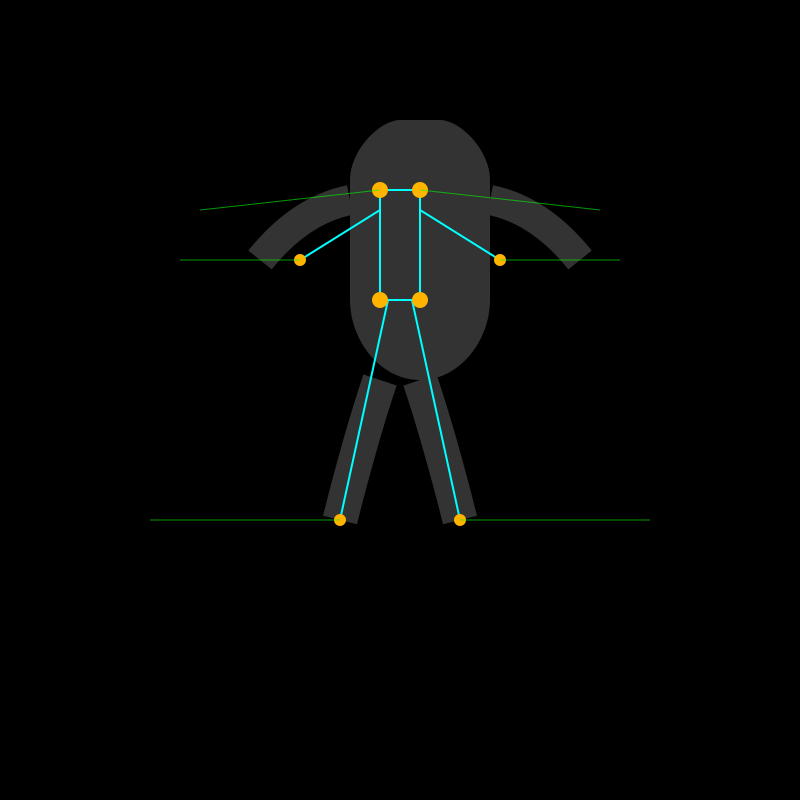
Version B · matched the vision 7/10 · critic's pick
The critic's comparison
What appeared that wasn't imagined: The fractal veil in B is generated via feTurbulence, creating an organic, shifting texture that feels more like 'peeled-away visual streams' than the static curves in A.
What Bodham learned about imagining versus making: The vision described a dynamic, living system, but the making reveals that achieving 'rippling' and 'shifting' in static SVG requires clever filters and gradients, not just lines and shapes.