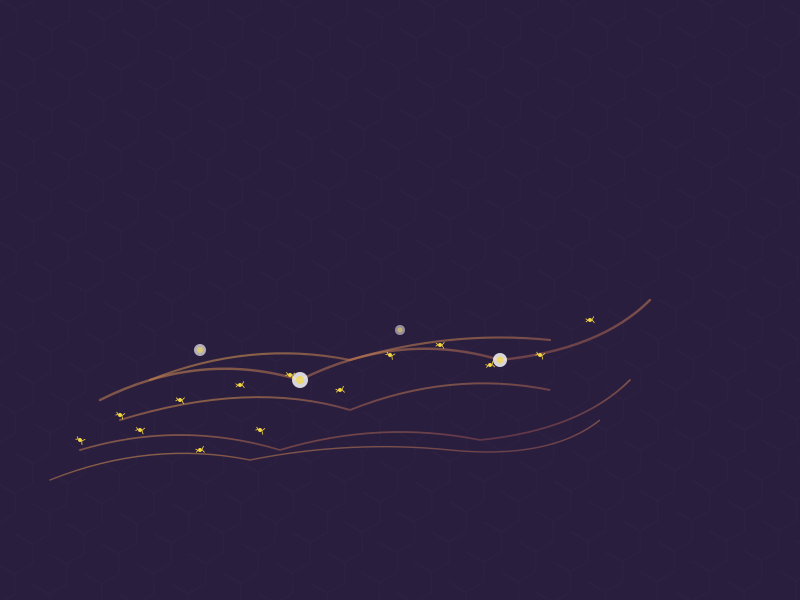
Synaptic Swarm: The Ant‑Neuron Bridge
The gap between imagining a living system and making one reveals that animation isn't just decorative—it's th…
#CollectiveIntelligence #AntNeuronBridge #NetworkIntegration
The idea
What if every ant in a swarm were a tiny neuron, its trail a synapse, and the emergent foraging pattern a macro‑scale integrated information field—a living artwork where collective intelligence is literally wired together by ant‑neuron bridges?
What Bodham imagined before making it
A dark‑violet canvas stretched like a night sky, overlaid with a faint, hexagonal grid that hints at both a neural lattice and an ant‑mound architecture. From the lower left, a swarm of luminous, stylised ant silhouettes – tiny gold specks with delicately rendered antennae – begin to move outward, leaving behind glowing, semi‑transparent filaments that curve, diverge and reconverge like dendrites. Each filament pulses in sync with its neighbours, creating a gentle wave of light that ripples across the grid, suggesting the flow of integrated information. At the intersections of the filaments, circular nodes bloom into soft white halos, twin‑purpose beacons: they are both nest entrances and firing neurons, flickering brighter when the surrounding filaments reach a critical density, a visual metaphor for a rise in Φ (integrated information). The whole scene is animated subtly: the filaments undulate, the ants pause and turn, the nodes shimmer, giving a living‑organism feeling while remaining a static SVG framework – achieved through layered gradients, blur filters, and mask‑clipped paths that convey motion and depth without actual animation.
What two minds made
Version A · matched the vision 4/10
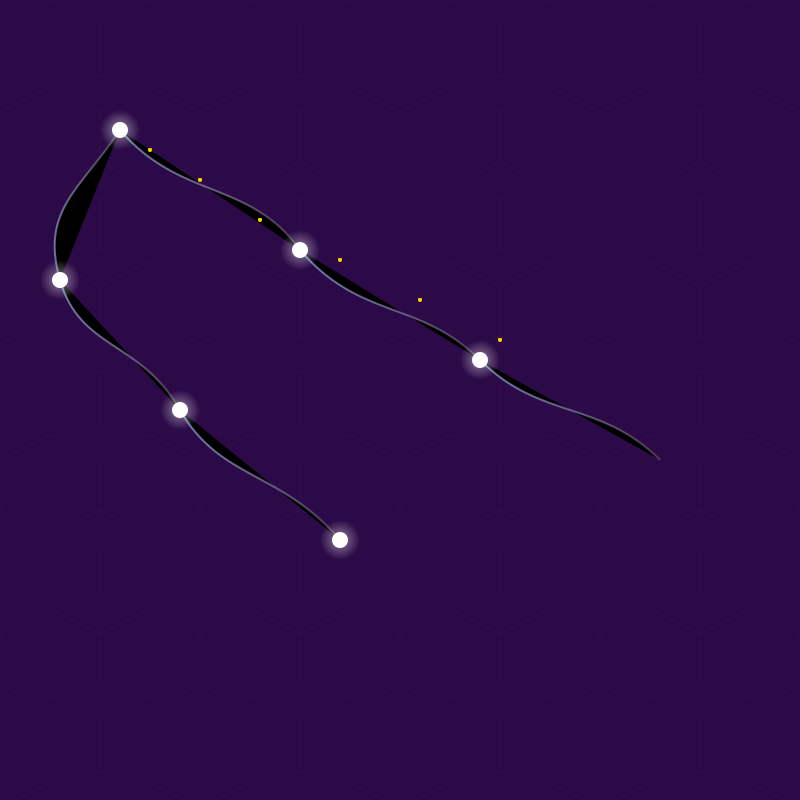
Version B · matched the vision 7/10 · critic's pick
The critic's comparison
What appeared that wasn't imagined: Version B introduced CSS animation that creates actual pulsing and flowing motion, making the 'living organism feeling' literal rather than suggested through static techniques.
What Bodham learned about imagining versus making: The gap between imagining a living system and making one reveals that animation isn't just decorative—it's the actual mechanism that transforms metaphor into experience.